Sunday, November 06, 2005

Cow-Tipping Myth Hasn’t Got a Leg to Stand On

Cow-Tipping Myth Hasn’t Got a Leg to Stand On
(Times Online)
Ms Boechler, now a trainee forensics analyst for the Royal Canadian Mounted Corps, concluded in her initial report that a cow standing with its legs straight would require five people to exert the required force to bowl it over.

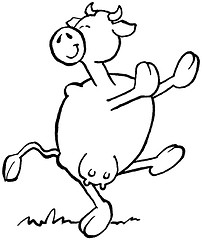
Ballet-dancing bovines were unavailable for comment.


Image © Marva Maid.

Saturday, November 05, 2005

Where Did Jesus Get His DNA?

Some Ask: Where Did Jesus Get His DNA?
(Philadelphia Inquirer)
But there’s a problem with arguing that Jesus came about through cloning or parthenogenesis—he would have been born a girl. In the last few decades science revealed that to be male you need a Y chromosome and the only place you can get one is from a man.

Who’s your daddy?

Friday, November 04, 2005

“Darwin” Defends Evolution

“Darwin” Defends Evolution
(University at Buffalo Reporter)
He interspersed humor with examples of basic evidence that support evolution. He noted that numerous vestigial organs and other extraneous features in the human body, such as some muscles, serve no discernible purpose. There are at least 100 vestigial parts in the body, he said. In addition to such well-known examples as the appendix or tonsils, Herreid cited goose bumps and muscles that wiggle the ears or move the scalp, the last of which he wryly demonstrated.

Sounds like a good way to work on those poll numbers.

Beam Me Up, Godly Being

Beam Me Up, Godly Being
(Slate)
Speculation about extraterrestrial beings is ancient, but “alien abduction” as we know it originated in the 1960s, after a New Hampshire couple named Betty and Barney Hill claimed to have been kidnapped by extraterrestrials. Betty was a fan of movies like Invaders From Mars. Her story inspired a best-selling book, a TV movie, and Steven Spielberg’s Close Encounters of the Third Kind. Many more people began to report abductions, which in turn led to more books and movies, which led to more people claiming to have been abducted—in a sense, it was Hollywood that had abducted them.

Thursday, November 03, 2005

Can Biology Do Better Than Faith?

Can Biology Do Better Than Faith?
Edward O. Wilson (New Scientist)
So, will science and religion find common ground, or at least agree to divide the fundamentals into mutually exclusive domains? A great many well-meaning scholars believe that such rapprochement is both possible and desirable. A few disagree, and I am one of them. I think Darwin would have held to the same position. The battle line is, as it has ever been, in biology. The inexorable growth of this science continues to widen, not to close, the tectonic gap between science and faith-based religion.

Biology certainly does better, for those who have faith in it.
Tuesday, November 01, 2005

Weird Science

Weird Science
(Salon.com)
It’s well known that much of the organic material from outer space to reach the prebiotic Earth came in the form of flat, sturdy molecules called polycyclic aromatic hydrocarbons, or PAHs. Platts began to see how PAHs could have been energized by solar radiation and self-assembled into stacks in the ancient ocean. Small, flat amino-acid molecules would begin to stick to the outside of this “stack of plates,” and the whole array would begin to look “for all the world like the information-rich genetic sequence of DNA or RNA.” This would have been nothing more than an intriguing, left-field notion if not for the fact that the space between these PAH layers is 0.34 billionths of a meter, which just happens to be precisely the distance between the ladder-like rungs of a DNA or RNA molecule. Somehow—and Platts doesn’t propose exactly how—this interesting but haphazard assemblage of molecules became a coherent vector of biochemical information, broke free of its PAH host and folded over on itself to become a “true pre-RNA genetic molecule.”

Andrew O’Hehir writes about Robert M. Hazen’s book Genesis: The Scientific Quest for Life’s Origins.

Communicating

Forbes Special Report on Communicating
(Forbes)

Plenty of easily digestible snippets—interviews, excerpts, slideshows, audio, video, polls, etc. Worth your while.